

Free Case Evaluation Find Out if You Have a Lemon Today
Our team will ask you simple questions to determine if we can help you receive a cash settlement or refund for your vehicle.
Check if You Qualify
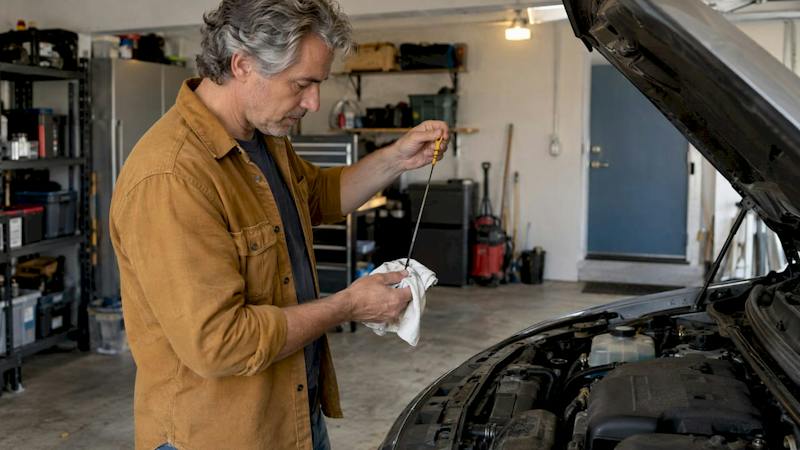
Excessive oil consumption can qualify a car for California lemon law protection. The oil guzzling car needs to be covered by a manufacturer's warranty. The oil problem also needs to substantially affect its use, value, or safety. And the manufacturer or its dealer must have failed to fix it after a reasonable number of attempts. If your engine keeps burning through quarts between oil changes and the dealer keeps telling you it is "normal," the paperwork you build from here on matters as much as the defect itself.
This guide explains how the law treats oil consumption, how to tell whether your numbers are excessive, what to keep track of, and what to do when the manufacturer pushes back.
Every engine uses oil. The trouble starts when a car burns it fast enough that you have to add quarts between changes, or when the oil level drops far enough to become a risk to the engine. Common causes include piston ring or cylinder wall problems, valve seal wear, and design flaws in particular engine families. Owners often first notice a low-oil warning light, blue smoke on startup, or a dipstick that reads low a few thousand miles after a fresh change.
From a legal view, the cause matters less than the result. Under California law, a defect counts when it is covered by the express warranty and substantially impairs the vehicle's use, value or safety. An engine that can run low on oil between services can create a real safety risk, since running low can damage the engine or cause it to stall. It also hurts value and forces constant top-ups. That is why oil consumption claims are a regular part of lemon law practice.
The Ninth Circuit described the elements of a Song-Beverly claim in an oil consumption case, Smothers v. BMW. The vehicle had a nonconformity covered by the express warranty that substantially impaired use, value or safety. It was presented to an authorized repair facility. And the manufacturer did not repair it after a reasonable number of attempts. The court's opinion in Smothers v. BMW lays out those three elements. It is worth noting the plaintiff, Smothers, lost his appeal on statute of limitations grounds because he waited more than four years after those failed repairs to sue. This underscores the importance of speaking with an attorney as soon as you suspect a recurring defect that has merit.

Here is the frustrating part: California law does not set a fixed number of quarts per mile. The standard is whether the problem is a warranty defect that the manufacturer failed to fix. Still, manufacturers publish thresholds in service bulletins to dealers, and those numbers are useful to know. They show what the industry itself treats as worth investigating.
The examples below come from technical service bulletins filed with the National Highway Traffic Safety Administration. They are specific to the vehicles they cover, so treat them as reference points, not a specific cars limit.
| Bulletin | Vehicle or engine | What it says |
|---|---|---|
| 2019 dealer job aid | Honda | At one quart or more every 1,000 miles, follow normal troubleshooting. At one quart every 1,000 to 3,000 miles under normal driving, contact the parts and service manager for an assessment. |
| 2017 bulletin | Passenger vehicles covered by that bulletin | Excessive consumption, not caused by leaks, is one quart (0.9 L) or more within 2,000 miles (3,200 km). |
| 2017 bulletin | Milwaukee-Eight motorcycle engine | Acceptable consumption is one quart per 1,500 miles, with the oil level checked at 500-mile intervals during a test. |
| 2023 bulletin | Gen 5 DD13 heavy-duty engine | One quart in under 700 miles is considered excessive. |
The pattern is clear. Many makers treat roughly a quart per 1,000 to 2,000 miles as the point where a dealer should look closer, and some engines have tighter limits. Dealers often run a formal "oil consumption test," where the oil is changed, the level is measured, and the car is driven a set distance before it is measured again. A trade publication notes that modern passenger car engines usually use less than 0.05% of their fuel volume in oil, and workshop manuals often give a maximum permitted figure for a specific engine.
Do not argue over a number with a service advisor. Measure your own usage, write it down, and put it on the repair order.
This simple log turns a vague complaint into a documented complaint.
The California Attorney General's office says the lemon law applies to most new vehicles bought or leased in California that are still under the manufacturer's new-vehicle warranty. It also applies to used vehicles that come with a manufacturer's new car warranty on the sale. The Department of Consumer Affairs adds that coverage reaches cars, pickups, vans, SUVs, the chassis and drive train of a motor home, dealer-owned vehicles and demonstrators. It also covers vehicles bought or leased mainly for business use, if the business has fewer than five vehicles and the vehicle's gross weight is under 10,000 pounds.
The same state office notes that full-time active-duty military members stationed or living in California at the time of purchase or lease are protected, even if the vehicle was bought or registered elsewhere.
A few practical notes for oil consumption cases:
For a fuller checklist of what a claim needs, see California lemon law requirements.
California gives you a shortcut. Under Civil Code section 1793.22, a reasonable number of repair attempts is presumed if either of the following happens:
These are presumptions, not hard requirements. A case can still succeed with fewer visits, depending on the facts, and a presumption can be challenged. But for a recurring oil problem, counting visits is the first thing a lawyer will do.
Two details trip people up. First, the direct notice to the manufacturer: the dealer telling the factory is not the same as you writing to it. Use the address in your owner's manual or warranty booklet. Second, the DCA explains that a consumer must request arbitration to claim the benefit of the presumption where the manufacturer offers a state-certified program, a point we return to below. The DCA lemon law Q&A describes how that works.
Oil cases (and many other claims) are won on paper. Dealers frequently write "could not duplicate," "consumption within spec", or "no problem found." Those entries are still evidence that you came in for a reason and made a complaint.
A consumer advocacy guide recommends writing to the manufacturer at the address in the owner's manual, keeping notes on phone calls, saving all work orders, receipts and emails, and always insisting on a work order from the dealership, even when the dealer fails to diagnose the problem.
Build a file with these items:
A simple tip: when you drop the car off, say the oil complaint out loud and then check the written order before you sign. If the advisor wrote "oil change requested," ask for it to be corrected.
Our guide on how to build a strong lemon law case goes deeper on organizing a file.
This is the most common response in oil cases. A dealer may say the engine is within a published allowance, or that a new car needs a "break in" period, or that your driving style is to blame. It helps to know the steps available to you.
Each documented visit for the same complaint is a repair attempt. Do not stop returning because the dealer is dismissive. A "no problem found" order still counts as presenting the car.
Send a letter to the address in your owner's manual describing the problem, the dates of repairs and what you want done. Keep proof of delivery.
When a manufacturer will not accept that the problem is a defect, a lawyer can review your repair orders, your oil log and the bulletin history for your engine. Many manufacturers have issued bulletins or extended-warranty programs for specific engines. That history can show the company knew about the problem.
When a car qualifies and the manufacturer cannot fix it, the law's remedy is a replacement vehicle or restitution, meaning a refund of what you paid, with adjustments for items such as use of the car. In practice, many owners choose a repurchase or a cash settlement. A lawyer can explain which outcome fits your situation and how the numbers are calculated for your contract, including loan payments, down payment and fees.
At Quill & Arrow, attorney fees in qualifying cases are funded by the manufacturer, and we work on a contingency basis, so you don't pay unless we win.
Song-Beverly warranty claims carry a four-year limitations period, borrowed from the state's commercial code. A California appellate court confirmed that the period is four years and that a cause of action accrues when the breach occurs or should have been discovered.
The oil consumption case Smothers v. BMW shows why timing matters. The Ninth Circuit said the owner's claim began to run no later than December 2013, when he knew the problem persisted after several repair visits. Absent tolling or estoppel, it was untimely by December 2017, per the court's decision. The court also reasoned that a reasonable investigation, including raising the oil consumption issue explicitly with technicians, would have revealed the problem.
The lesson is simple. Once repairs fail and you know the problem remains, the clock may be running. Do not wait for the warranty to expire or for the car to break down before getting advice.
If your car is burning through oil and the dealer keeps sending you home, a free case review is a no risk way to find out where you stand. Our approach is to prepare every case as if it will go to trial, which is designed to give you leverage against the manufacturer. We have recovered approximately $150 million for thousands of car owners. You get real-time case tracking, and you pay nothing out of pocket.
Start with our California lemon law page, or if you drive a pre-owned car, read about used car lemon law representation. You can also reach us through the Quill & Arrow home page.
If you answer yes to most of these, your file is already stronger than most. If you answer no to some, you can still get in touch. A lawyer can tell you what next steps to take.
It can be under the right criteria. If the oil consumption is covered by your warranty, substantially affects the car's use, value or safety, and the manufacturer cannot fix it after a reasonable number of attempts, it can qualify. Repeated repair visits and a clear paper trail make the case much stronger.
There is no defined figure set by California Law. Manufacturer bulletins commonly treat about one quart per 1,000 to 2,000 miles as the range where dealers should investigate, though limits can vary by engine. Track your own usage and have it written on every repair order.
The law presumes a manufacturer had a reasonable number of repair attempts, if within 18 months or 18000 miles (whichever of those comes first), the vehicle has had four or more repairs for the same problem (2 or more if it is serious safety defect), or more than 30 cumulative days in the shop. You also generally need to have notified the manufacturer directly at least once if required by your warranty booklet. You can still support a valid claim depending on the facts, even if you fall outside of these guidelines.
The key question is whether the defect arose and was reported while the warranty applied. If you first complained about oil use during coverage and repairs failed, you may still have a claim, subject to the four-year limit. A lawyer can review your dates.
It can yes. Lessees can have lemon law rights under the proper criteria, and the process is the same as for owners. Check out our guide to lemon law for leased vehicles walks through it.
Our team will ask you simple questions to determine if we can help you receive a cash settlement or refund for your vehicle.
Check if You Qualify